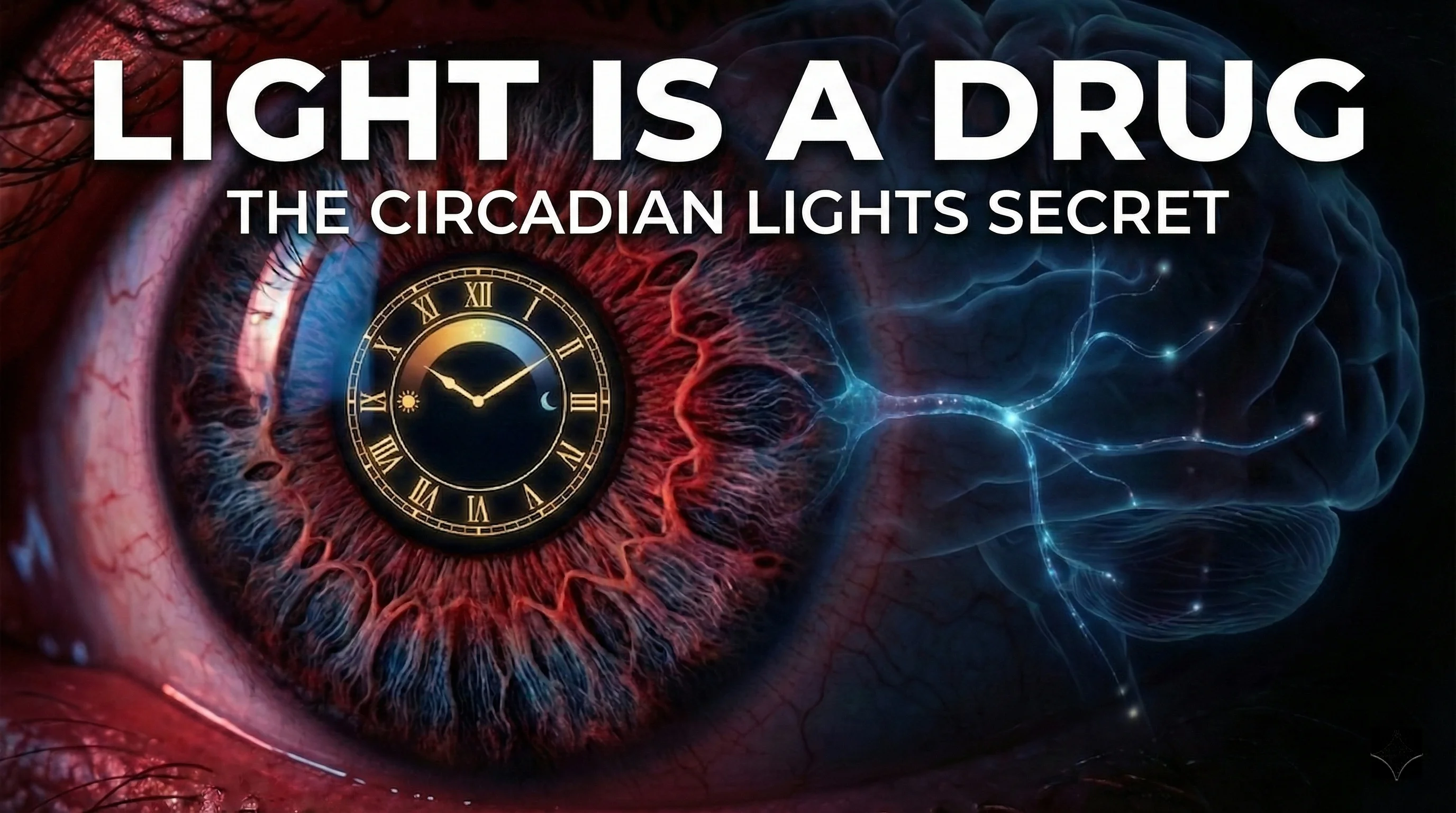
The Biological Renaissance: Why Your Home’s Light is the Secret to Health, Focus, and Sleep
Based on Science?
Get the tools used in this protocol.
For 99% of human history, our biology was governed by a simple, powerful rhythm: the sun. Today, we spend 90% of our lives indoors, trapped in what scientists call “Biological Darkness.”
Even if your room looks bright, your brain might think it’s midnight. This misalignment is the root cause of the modern epidemic of fatigue, mood swings, and insomnia. This guide will show you how to “re-program” your internal clock using the latest breakthroughs in circadian science.
1. The “Third Eye” You Didn’t Know You Had
Most people think eyes are only for seeing. But deep in your retina, there are “intrinsically photosensitive Retinal Ganglion Cells” (ipRGCs). These cells have nothing to do with vision; they are a direct data cable to your brain’s master clock (the Suprachiasmatic Nucleus).
The Master Switch
**Dr. Andrew Huberman (Huberman Lab)** *"Light is the primary way that our internal organs, our brain, and our nervous system stay synchronized to the outside world... the most important thing is to get bright light in your eyes as soon as possible after waking."*Scientific Proof: These ipRGCs come in six subtypes (M1-M6). The M1 subtype is the “director,” projecting directly to the brain centers that regulate your mood and metabolism <sup class=”scientific-ref”>1, 2</sup>.

2. The 480nm Secret: Why Kelvin is a Lie
The lighting industry sells bulbs based on “Kelvin” (Warm vs. Cool). But your brain doesn’t care about Kelvin; it cares about the Spectral Power Distribution (SPD)—specifically the blue light at 480 nanometers.
Standard LEDs have a “Blue Spike” at 450nm. It’s harsh, unnatural, and “blinds” your circadian system while keeping you awake at night.
The Problem with Standard LEDs
**Andrew LaTour (GembaRed)** *"Standard LEDs are deficient in the red end of the spectrum... they tend to have lower CRIs and don't represent the full spectrum of natural light, which is crucial for our biology."*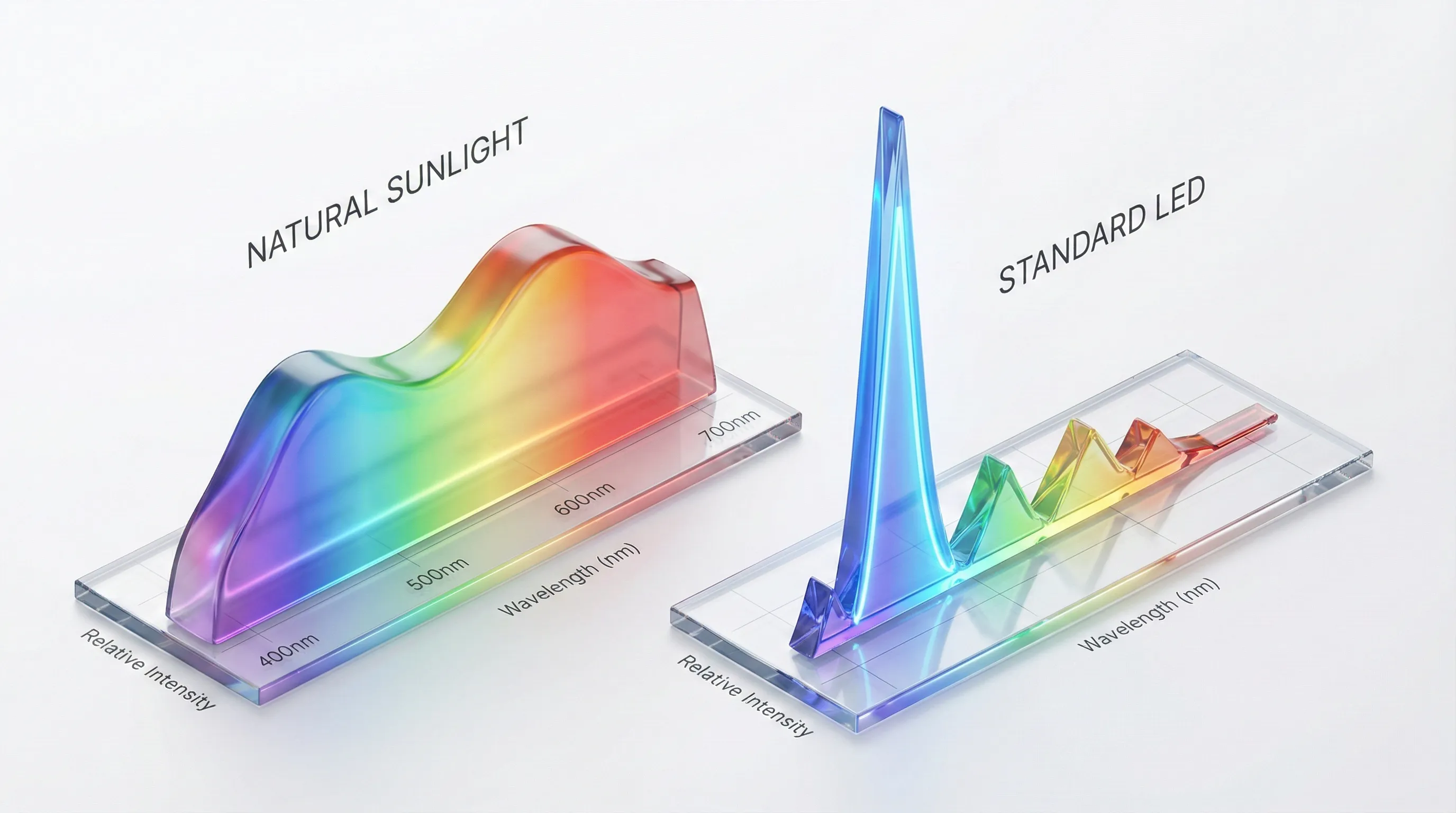
3. The “Dawn Detector” Mechanism
Recent research from the University of Washington has revealed that our brains don’t just look for “blue.” They look for the Violet-Orange contrast typical of a sunrise. This “Dawn Detector” is 1,000 times more sensitive than previous models suggested.
Scientific Proof: While the body usually needs 10,000 lux of white light to “wake up,” it can achieve the same reset with just 250 lux if the spectrum correctly mimics the low-solar-angle colors of dawn <sup class=”scientific-ref”>3, 7</sup>.
4. The Daily Protocol: Light as a Bioactive Drug
To optimize your life, you must dose light like a medicine at three specific times:
Phase 1: The Morning Reset (0-60 min post-waking)
Goal: Suppress Melatonin, trigger Cortisol. How: High-intensity, blue-rich light or “Dawn Detector” spectrums. This anchors your rhythm for the entire day.
The Importance of Timing
**Dr. Satchin Panda (Salk Institute)** *"If we don't get enough bright light in the morning, our brain's clock is not reset, and it will drift... affecting our sleep onset later that night."*Phase 2: The Afternoon Focus
Goal: Maintain cognitive acuity. Scientific Proof: Exposure to the correct daytime light has been shown to improve cognitive performance and response times by up to 12% <sup class=”scientific-ref”>6</sup>.
Phase 3: The Evening “Campfire” (2-3 hours before bed)
Goal: Melatonin onset. The Trap: Even a 5-minute exposure to a standard “cool white” LED at night can delay your sleep for hours. How: Transition to zero-blue light. Use bulbs that eliminate the 480nm spike, mimicking the warm glow of a campfire.
The Melatonin Bridge
*"If you are looking at blue light in the evening, you are effectively telling your brain it is mid-day, which suppresses melatonin by up to 50% and shifts your sleep-wake cycle."*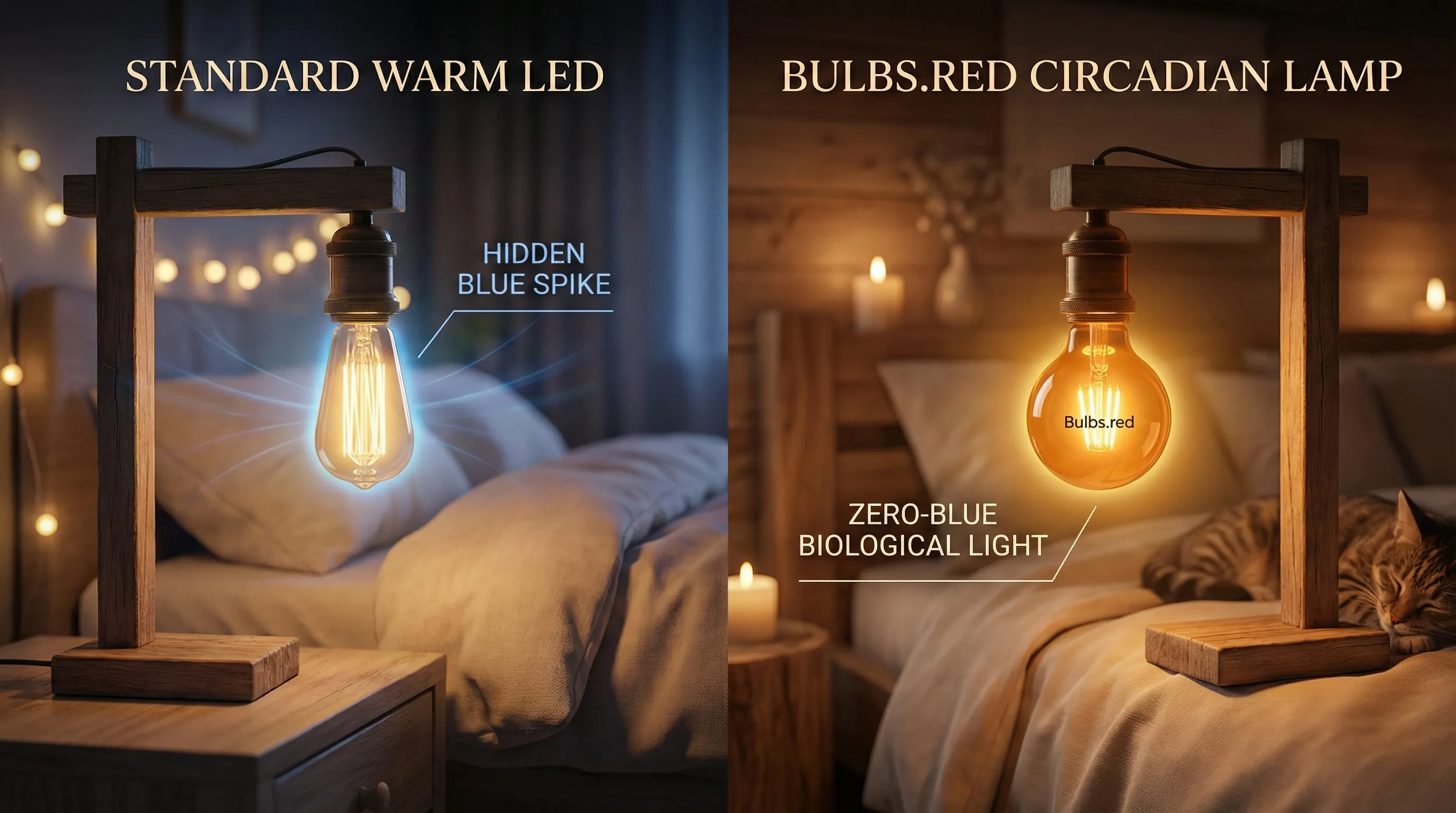
2. The 480nm Secret: Why Kelvin is a Lie
The lighting industry sells bulbs based on “Kelvin” (Warm vs. Cool). But your brain doesn’t care about Kelvin; it cares about the Spectral Power Distribution (SPD)—specifically the blue light at 480 nanometers.
Standard LEDs have a “Blue Spike” at 450nm. It’s harsh, unnatural, and “blinds” your circadian system while keeping you awake at night.
3. The “Dawn Detector” Mechanism
Recent research from the University of Washington has revealed that our brains don’t just look for “blue.” They look for the Violet-Orange contrast typical of a sunrise. This “Dawn Detector” is 1,000 times more sensitive than previous models suggested.
Scientific Proof: While the body usually needs 10,000 lux of white light to “wake up,” it can achieve the same reset with just 250 lux if the spectrum correctly mimics the low-solar-angle colors of dawn <sup class=”scientific-ref”>3, 7</sup>.
4. The Daily Protocol: Light as a Bioactive Drug
To optimize your life, you must dose light like a medicine at three specific times:
Phase 1: The Morning Reset (0-60 min post-waking)
Goal: Suppress Melatonin, trigger Cortisol. How: High-intensity, blue-rich light or “Dawn Detector” spectrums. This anchors your rhythm for the entire day.
Phase 2: The Afternoon Focus
Goal: Maintain cognitive acuity. Scientific Proof: Exposure to the correct daytime light has been shown to improve cognitive performance and response times by up to 12% <sup class=”scientific-ref”>6</sup>.
Phase 3: The Evening “Campfire” (2-3 hours before bed)
Goal: Melatonin onset. The Trap: Even a 5-minute exposure to a standard “cool white” LED at night can delay your sleep for hours. How: Transition to zero-blue light. Use bulbs that eliminate the 480nm spike, mimicking the warm glow of a campfire.
The Melatonin Bridge
*"If you are looking at blue light in the evening, you are effectively telling your brain it is mid-day, which suppresses melatonin by up to 50% and shifts your sleep-wake cycle."*5. Why Most “Smart Bulbs” are Failing You
Most “Circadian” lamps on the market simply change from blue to yellow. However, the internal LED still produces the 480nm “blue poison.”
The Test: Look for bulbs that specify m-EDI (Melanopic Equivalent Daylight Illuminance). A true circadian bulb will have a high m-EDI in the morning and a near-zero m-EDI in the evening, regardless of how “bright” it looks to the human eye <sup class=”scientific-ref”>4, 11</sup>.
6. How to Implement This Today (The “No-App” Solution)
You don’t need a complex smart home system to fix your biology.
- The 8-Second Toggle: Use bulbs with memory functions that cycle through “Daylight,” “Sunset,” and “Campfire” modes just by flicking your existing wall switch.
- The Vertical Plane: Remember that ipRGCs are most sensitive to light coming from above (like the sun) or at eye level. Position your lamps accordingly.
Conclusion: Reclaim Your Rhythm
Light is not just a utility; it is the most powerful drug in your environment. By eliminating Biological Darkness, you don’t just sleep better—you live better.
The science is clear: To optimize your life, you must first optimize your light.